Tag Archives: Inspiration

19th Sunday of the Year – Walking on Water

Walking on Water

Study:  Recall a moment in life when you were doubtful or afraid.  How did you face it?

Pray:  Ask the Lord for the strength and wisdom to face doubts and fears.

Serve:  Is there someone in your life who is struggling with doubts or fears?  How might you help them?

19th Sunday of the Year Readings

Fr. Andrew’s Homily

This Gospel story (Matthew 14:22-33) follows immediately after the reading from last week.  Here’s a quick recap:

* Jesus hears of the death of John the Baptist
* Jesus seeks solitude in a deserted place
* The crowds find Jesus; he ministers to them
* Jesus feeds the hungry with fishes & bread

After the people have eaten, the Lord makes the disciples get into a boat while he dismisses the crowd.  The following events occur:
1.  The disciples are in the boat on the water
2.  Jesus goes up the mountain to pray alone
3.  The wind and the waves are getting strong
4.  Late at night Jesus comes on the water
5.  Seeing Jesus, the disciples are terrified
6.  Jesus, “Take courage, it is I, do not be afraid!”
7.  Peter to Jesus “Command me to come to you.”
8.  Peter goes to Jesus, is frightened and sinks
9.  Jesus rescues Peter “Why did you doubt?”
10. The disciples:  “Truly you are the Son of God!”

Note that Matthew’s Gospel differs from Mark’s account (6:45-52) in three ways:
1.  The dialogue between Jesus and Peter
2.  Peter walking (sort of) on the water
3.  Confession of faith – Jesus the Son of God

The story speaks of Peter’s desire to follow Jesus, even as it clearly shows his human weakness.  Peter tries, fails, and calls upon Jesus to save him in his need.  As a result, the disciples recognize the Son of God in their midst.

The early Church took this passage to heart.  Like the boat tossed on the waters, early Christians knew all too well the dangers of faith – risking their lives to follow Jesus.  Like Peter, they had their moments of weakness; like Peter, they called upon the Lord in their need.

We can see ourselves in this situation as well.  There are times when we desperately want a strong and steadfast faith; we seek the Lord and desire to follow His path for our lives.  Yet we are also aware of our limitations, failures, and fears.  May we, like Peter, call upon Jesus in our need; may we trust in the Lord’s strength and love to save us.

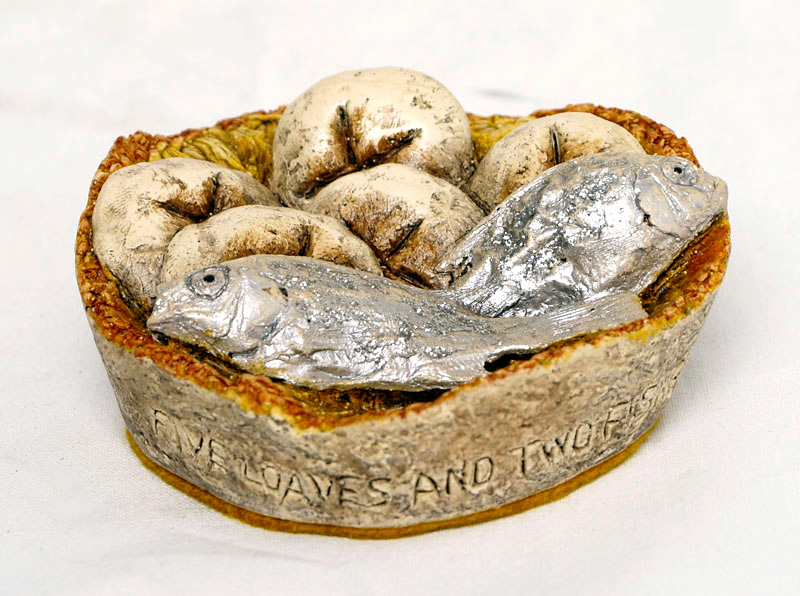
18th Sunday of the Year – a Miracle

fishes and loaves

Study:  Where in my life have I experienced God’s abundant grace?  Where and when have I encountered a miracle?

Pray:  Jesus met the people in their needs; perhaps we might come to the Lord with our concerns and fears.

Serve:  How might we be an instrument of grace for another today?  Has the Lord put someone in our life right now to serve?

18th Sunday of the Year Readings

Fr. Andrew’s Homily

The Gospel this week offers a familiar story that many of us have heard on numerous occasions.  The miracle of the fishes and loaves offers a rich opportunity to reflect on a variety of themes that are central to the Christian disciple.

In order to do this, let’s take a step-by-step review of this story:

1.  Jesus hears of the death of John the Baptist
2.  Jesus seeks solitude in a deserted place
3.  The crowds eagerly seek Jesus
4.  Jesus sees the crowds and pities them
5.  Jesus cures their sick
6.  The people are hungry and far from home
7.  The disciples tell Jesus to send the people away
8.  Jesus tells the disciples to feed the people
9.  The disciples say there is only 5 loaves & 2 fish
10.  Jesus TAKES, BLESSES, BREAKS, GIVES
11.  There is an abundance (leftovers of food!)

Here are a few observations:

1.  Jesus’ heart is moved with sorrow for the death of John the Baptist.  Perhaps he is considering his own approaching death, and he seeks some quiet personal time.  Yet when the crowds crush in upon him, the Lord pities and responds to their needs.  It is the generous and loving heart of Jesus that is worthy of reflection and observation here.

2.  Jesus observes that many people are sick, and the Lord takes the time to heal their bodies.

3.  The people have been with Jesus all day.  They are far from home, and they have not eaten.  While the disciples want the Lord to send them away, Jesus commands them to feed the people; when they use the limited food supply as their excuse, Jesus takes, blesses, breaks, and gives them an abundance.  Thus, Jesus cares for the people – body and soul in a way that is truly overwhelming.

4.  The same verbs of taking, blessing, breaking, and giving are used to describe the Lord at the Last Supper.  This feeding miracle is just another form of Eucharist!

Jesus moves beyond his own personal concerns to love, respond, and serve others.  The Lord cares for both the physical and spiritual needs of people in a generous way.  May we follow his example in our own lives of service and ministry.


17th Sunday of the Year – Making Choices

Making Choices

Study:  What decisions am I facing right now?  What resources can I turn to for guidance and direction?

Pray:  How does my faith in Jesus Christ help direct my choices?  Ask the Lord for insight!

Serve: Can I help someone right now who is facing a difficult choice?

17th Sunday of the Year Readings

Fr. Andrew’s Homily

Do you remember the old game show  Let’s Make a Deal?  The host was Monty Hall, a smooth talking guy who would present possible options to contestants.  Those lucky few who were selected could take a certain gift in front of them, or they could choose from behind door number 1, 2, or 3 for an unknown prize.

The catch was that no one knew what was behind the door.  Sometimes it was a bogus prize, worthless and unusual.  Sometimes it was a fabulous gift, many times more valuable than the first prize they could have had.

I use to “play” the game with my grandmother.  She and I would pretend that we were contestants.  We would decide whether we would have stayed with what we knew, or would have risked it on something unknown.  (And just for the record:   Grandma almost always won…..)

The principle of the game was simple.  Do you stay with what you have or do you risk it in the hope of winning much, much more?  When is it enough?  When are we satisfied? What is it that we really want?

Here are three points that often surface:
* Risk – What’s it worth to us?
* Priorities – What’s important to us?
* Satisfaction – When is it enough for us?

The game show’s appeal was strong because it was grounded in the same issues we face everyday.  Life is filled with uncertainty and new challenges; we are routinely confronted with choices which require us to make decisions that can have great and small consequences on our lives.  We have to explore a variety of questions, and in the process we learn a great deal about who we really are.

In the Scriptures today these choices are highlighted in the selection of Solomon and the Pearl of great price.  Confronted by choices, the people in the readings determine risk, priority, and satisfaction before making their decision.

The same is true for us.  God gives us opportunities everyday to make choices that reveal the content of our hearts.  Through our actions and decisions we discover what we value.  As we examine our lives this day, may we seek God first as we look to the Lord for guidance and wisdom to make good decisions.


16th Sunday of the Year – Weeds & Seeds

Weeding

Study:  What good thing in my life needs to be cultivated to grow?  What bad thing needs to be removed?

Pray:  Do I see the issues in my heart with clarity and honesty?  Ask the Lord for guidance.

Serve:  Can I help someone to grow?  Are there opportunities right now where my service can help others become stronger and better?

16th Sunday Readings

Fr. Andrew’s Homily

I love spending time in a garden.  I love watching the beauty of nature unfold from spring to fall as the plants grow and mature.  My moments in the garden are times for solitude (its just me and the mosquitoes).  I pray, reflect on current issues and needs, and enjoy the satisfaction which comes from time well spent.

I will also freely admit that when I get the chance I actually like weeding.  As a boy I hated it; the work seemed like a punishment and a useless chore.  Yet now I look forward to the time I can spend without care or worry as I dig out unwanted weeds.

That’s a good thing since weeds do not stop growing!  I can spend hours working in the garden, making sure that it is immaculate and pristine, and come back the next day to find a new set of weeds stubbornly about the business of growing right in the midst of my peppers, tomatoes, and basil.

Weeds are persistent (as anyone who has been away from the garden for more than a week knows), and if left untouched can and will take over a garden – choking out all the other plants.

In the Gospel today Jesus uses the example of weeds and seeds to convey some basic truths about our lives:
1.  Patience is required to let the seeds grow.
2.  Weeds are a part of life.

Every gardener knows that you cannot force a plant to grow; it develops over time at a set and natural pace.  Patience is necessary to allow the seed to change and transform to full maturity.  The plant needs time and steady attention if it is to flourish.

Gardeners also know that weeds are always present.  Only through constant care and attention can a person stay on top of the weeds; discipline is required if the garden is to be kept in control.

The fact is, we live in the garden of life.  Like a seed, we grow and mature through time and constant attention.  Only through patient application can we become the creation that God dreams us to be.

Yet we also know that in our life there are weeds.  Temptation and sin are a part of our world, and if left unattended they threaten to choke us off from God and one another.

May we place our trust in Christ, the master gardener, to help us with the weeds and the seeds!


15th Sunday of the Year – Weeds, Seeds, and Growing Things

Garden 1

Study:  What are some virtues that you would like to cultivate in your life?  What are some vices that need to be weeded out?

Pray:  Everyday provides a new opportunity for personal growth.  Ask the Lord for the strength and wisdom to grow in holiness.

Serve:  Name one little thing you can do for another; now make it happen.

15th Sunday Readings

Fr. Andrew’s Homily

Since returning to the Cathedral as rector five years ago, one thing I miss is gardening.  Time is precious, and my current work does not readily lend itself to the effort it takes to keep a garden.  Yet all things being equal, there is no place I would rather be than rooting around in the dirt – picking weeds, pruning, staking, watering, hoeing, and “looking at” the plants.

Gardening is a metaphor that teaches us about ministry and life.  Spending time in the garden forces us to slow down and attend to a cycle that is not our own.  We pay closer attention to the wonder and beauty of nature, and we can be surprised and  amazed by what we see.

Plants truly are hopeful optimists in a world of pessimism.  Every year my flowers and vegetables produce thousands of seeds, each seed capable of new and beautiful life.  Yet for all these seeds only a few survive.  Some are taken as produce, some by the weather, and some by the rabbits!

Nature knows that life is difficult.  There are so many obstacles and challenges in the world that it is essential to cast hundreds and thousands of seeds, just so that a few might be able to continue the cycle of life.  The power of nature is that even a few seeds can change the landscape, bringing nourishment and beauty to the earth.

Jesus knew this.  He spoke to hundreds and thousands of the hope and life that are possible in His Father’s Kingdom.  He cured countless people and preached tirelessly to any who would hear.  Like the garden plants, he cast LOTS of seed.

Yet many people did not act on his message.  Many mocked him, plotted against him, or simply walked away.  Some got excited for a time, but then they got bored, discouraged, or caught up in other interests.  Simply put, much of the seed cast by Jesus was lost or destroyed.

Yet in his parable to the crowds Jesus shows his tremendous hope.  It only takes a few seeds for an incredible harvest!  A 30x, 60x, or 100x harvest was amazing in the ancient world (and it is not too shabby today!).  For those who heed the word of God, they, too, will yield a crop that will defy worldly doubt.

I’m willing to bet that all of us continue to carry the Lord’s seed in our lives.  The invitation today is that it will take root and flourish in our hearts.  We are given the chance to garden our souls, fostering a faith that is worthy of the Lord’s harvest.


14th Sunday of the Year – Meek & Humble of Heart

Humility Quote

Study:  Name someone in your life who lives with sincere humility.  What behaviors stand out?

Pray:  Humility comes from knowing ourselves – warts and all.  Ask the Lord for the insight to truly see the blessings & burdens, successes and sins, that lie in our hearts.

Serve:  Is there a thankless or difficult task that you can do for another?  Can it be done with a loving sincerity?

14th Sunday Readings

In June of 1994 I came to Rome.  I had lived in the Holy Land since January and I was making my visit to my Italian roots as the last part of my journey. I stayed at the Benedictine monastery and school – St. Anselmo – which was governed by a monk from St. John’s, Abbot Jerome Theisen.

Abbot Jerome was a remarkable man.  A brilliant scholar with a pastoral heart, his duty as Abbot Primate was to visit Benedictine monasteries around the world – working to improve and strengthen monastic life across the globe.  Yet for all the travel and prominence of his work, Abbot Jerome was a gentle and humble man.

Shortly after he had arrived in Rome, the Abbot Primate began a regular routine of gardening each day.  He firmly believed in the Benedictine phrase, “Ora et Labora” (Prayer and Work) and set an example for the other monks by taking a certain amount of physical exercise each day.

On one particular morning, Abbot Jerome was out in the monastic gardens at work among the roses.  He was wearing a plain and well worn habit, devoid of any finery or ostentation.  He looked like a simple monk – and somewhat grubby at that!

While he was in the middle of his weeding a monk from another religious order came calling.  Seeing the elderly “brother” on his knees in the dirt he said, “Brother, is the Abbot Primate here today?”

Abbot Jerome replied, “Yes, he is here.”

The monk said, “I wish to speak with him.”

Abbot Jerome stood up and responded, “Very well.  What would you like to discuss?”

The monk, affronted by the impertinence of a dirty, sweaty “brother” (for what priest would be gardening…?) said, “Brother, I am an Abbot, and I demand to see the Abbot Primate AT ONCE!”

Abbot Jerome dusted his hands off his black habit, and extended his right hand in greeting.  He gently said, “Certainly.  I am Abbot Jerome.  How can I help you?”

The embarrassed monk stuttered an apology, and after a few moments excused himself.

************

I have often thought of Abbot Jerome’s example.  Regardless of wealth, learning, or status, may we have the perspective to see ourselves, called by God to a meek and humble heart!


Saints Peter and Paul

Peter and Paul

Study:  What are the unique gifts that God has given me?  How might I be called to share my life with others?

Pray:  Ask the Lord for the guidance and direction you need.

Serve:  What needs are before you right now?  How can you help another with your life?

Saints Peter and Paul Vigil Mass Readings

Saints Peter and Paul Sunday Mass Readings

Every year on June 29th the Church celebrates two of its greatest figures – Saint Peter and Saint Paul.  Since this feast falls on a Sunday, we transfer the readings and prayers of this feast to all the weekend masses.

When you think about the influence that these saints have had through their leadership, writing, and example it is easy to see why the Church chooses a day to honor their memory.  Their lives are part of the very foundation of our faith; they were human instruments by which God was able to share the Good News of Jesus Christ.

Saint Peter, for all his human weaknesses and failings, offered his leadership for the early Church.  The very fact that he made mistakes, spoke out of misunderstanding, and sometimes let fear and doubt cloud his judgment is the very reason why many people respect him.  Rather than get frustrated or dejected, he kept getting up and following Christ.

Saint Paul, who formerly persecuted the Church, would become its greatest advocate through his immense number of letters, exhortations, and journeys.  At times misunderstood or openly attacked, he continued to proclaim the message of Christ.

Life was not easy for these men!  They were physically tortured, imprisoned, falsely accused, mocked, ridiculed, beaten, and at times abandoned.  They gave up their families, their careers, the stability of their lives – ALL FOR THE LOVE OF CHRIST.

In the end, this immense personal sacrifice would culminate with the greatest of all offerings: they would give their lives for their faith.  Peter would be crucified upside down (stating that he was unworthy to die in the same way as his Lord).  Paul would be beheaded.  Their deaths both took place in Rome, where they spent the last days of their lives, teaching and preaching in the name of Jesus.

These men were some of the very foundation stones of our faith.  Upon the example of their lives we have built our Church.  We are their living legacy; their example inspires us.

Yet they also remind us of our obligation to the next generation.  Just as Peter and Paul shared their faith, so too we are called to do the same.  We have the opportunity to continue their work, and thus be an example to future Christians of the love and faith that comes from Jesus Christ.


The Body and Blood of Christ

Holy Communion

Study:  Reflect on the last time you received Holy Communion.  Were you attentive to the great gift of Jesus Christ – body & blood, soul & divinity – that you received?

Pray:  The next time you are at Mass, take a moment to prepare yourself to receive the Lord with an open heart.

Serve: Communion gives us strength to do the Lord’s work; who in my life could use a helping hand today?

The Body and Blood of Christ Readings

I love pasta.  I love to cook it; I love to eat it; and I can spend hours talking with family members and friends in order to learn more about how different sauces and seasonings affect flavor and taste.

In addition, I enjoy the numerous shapes and styles of pasta.  Spaghetti is a timeless classic, but there is also vermicelli, cappelini, fettuccine, conchiglie, tagliarini, cappelletti, tortellini, ravioli, rigatoni, ziti, m0staccioli, farfalle, cannelloni, campanelle, lasagna, penne rigate…….!

The list goes on and on in an immense and diverse variety of forms.  Different sauces work better with particular shapes, and cooking styles differ from one pasta to another.

And yet with all of this variety, pasta is still a very simple food.  While it has a place of honor in Italian cooking (did I mention I am Italian?), it can be found in most cultures – each sporting unique ways to prepare this basic form.

Food is an essential need in all life.  We need food to survive physically, yet food is more than just sustenance. When people gather to eat, food often becomes the means to draw others into conversation, companionship, and celebration.  Thus, food can nourish the body and the soul.

Jesus knew this simple fact.  He fed people when they were hungry (Mt 14:13-21, Mk 6:30-44, Lk 9:10-17, Jn 6:1-15, Mt 15:32-39, Mk 8:1-10).  The Lord met this basic need repeatedly, helping people to be physically sustained by giving them bread to eat.

Yet Jesus makes an astonishing claim.  He says that he is the living bread (Jn 6:51).  Thus, Jesus not only gives the people food, but he tells them that he is the food they need for eternal life.  This claim is underscored in the Gospel today, and it is supported by the words of Jesus at the Last Supper (Mt 26:17-29, Mk 14:12-25, Lk 22:7-20, and 1 Cor 11:17-34).

Every time we gather for Mass we follow the Lord’s command to take bread and wine and in His name receive His Body and Blood.  The Lord becomes food for us that we might have life in this world and in the next.  As we receive Communion may we recognize that the Lord Jesus is near, offering us his very self that we might have the food of eternal life.


The Most Holy Trinity

Holy Trinity

Study:  When in your life have you experienced love without words?  How did you know that you were loved even when nothing was said?

Pray:  Ask the Lord for guidance – who am I called to love today?  How am I called to love?

Serve:  What random act of kindness can I offer today for another?  How can I let the Love of Christ shine through my efforts?

Holy Trinity Readings

Fr. Andrew’s Homily

In my travels I have found myself on occasion in the company of people who did not speak English.  Indeed, when I would try my limited Spanish or Italian (or even my Latin!), I found that we had no common foundation upon which to communicate.  I wanted to share my thoughts, but I did not possess the medium to make it happen.

As I was explaining this frustration to one of my professors, he shared with me a common language that affects us all.  It is a language that all of us can understand even though we use different words to explain it.  The language?  Mathematics.

Imagine the number five (“5”).  Around the world the number is essentially the same, yet the word to describe it is very different:
In English:    “five”
In Italian:    “cinque”
In Greek:    “pente”

You get the idea.  The number means the same, but is spoken in a different way in each language.

Through time and space God has come to humanity in many different ways.  God has communicated to us through different instruments (Prophets, Dreams, Visions, Saints, Nature…), and God has spoken in many different languages (Jesus spoke Aramaic, the New Testament is written in Greek, St. Augustine wrote in Latin…).

Yet God uses one word again and again among us – LOVE.  Indeed, we are told that God is love (1 John 4:8).  This love is seen most clearly in the mystery of the Trinity, where God comes to us in love to teach us how to love one another.

God the Father created us in love.  God the Son redeemed us out of love by his death and resurrection.  God the Holy Spirit sustains us in our lives to put this love into practice.

Jesus speaks of the love of the Father (John 15:9), and the Lord tells the disciples that out of love he will ask the Father to send the Spirit (John 14:16).  Love is the reason God made us, God saved us, and God strengthens us today.

If love is the language God shares with us, then we are invited to speak this language in our lives. Our call as Christians is to proclaim in our words and actions the love of God – Father, Son, and Holy Spirit.  For if our love is sincere, then it will communicate in a language that breaks all boundaries.


The Feast of Pentecost


Holy-Spirit-Dove

Study: Where in my life have I experienced God’s grace and strength?

Pray:  What particular needs in my life call for the help of the Holy Spirit?

Serve:  Where can I use the gifts God has given me to serve another right now?

Pentecost Mass Vigil Readings        Pentecost Mass Day Readings

Fr. Andrew’s Homily

The image St. Paul uses in the 2nd reading this weekend is a body.  Composed of different parts which do unique and special functions, the body is united when all the parts come together.  So, too, all of us are united into the Body of Christ through the power of the Holy Spirit.  Look at these themes from Pentecost Mass Readings of the Day:

  • The Spirit gives power to communicate across barriers of race and tongue (1st Reading)
  • The Spirit gives life and renews the face of the earth (Psalm response)
  • The Spirit gives different gifts to people for different needs (2nd Reading)
  • The Spirit is breathed on the disciples by Jesus (Gospel)

In other words, the Holy Spirit unites people, renews life, provides unique gifts, and is granted to the Church by Christ.  This is the day that the disciples were empowered to continue the mission of Jesus; filled with the Spirit they will witness the Good News of the Lord through their words and actions.

Their example becomes our model.  The same Spirit that changed their lives comes to us.  The same Spirit that gave them the grace and strength to go forth gives us the power we need to offer our lives for Christ.  God continues to invite us to serve, and the Lord pours forth the Holy Spirit to help us carry out the work of this day.

Are there barriers in our life?  Come Holy Spirit!

Are there parts of life in need of renewal?  Come Holy Spirit!

Are there gifts we have that need to be used and directed?  Come Holy Spirit!

Jesus freely gave the gift of the Spirit to his disciples – may we turn to the Lord with conviction that as we call for the Holy Spirit in our lives we will be given what we need for the work of this day.

Come Holy Spirit, fill the hearts of your faithful and kindle in them the fire of your love.
V. Send forth your Spirit, and they shall be created.
R. And You shall renew the face of the earth.

Let us pray.

O, God, who by the light of the Holy Spirit, did instruct the hearts of the faithful, grant that by the same Holy Spirit we may be truly wise and ever enjoy His consolations. Through Christ Our Lord. Amen.