Category Archives: Feasts & Solemnities

Solemnity of All Saints

all-saints-picture-1511

Study: Consider the people who inspire you.  What qualities do they possess that speak to your mind and heart?

Pray: Invoke your favorite saint(s) in you daily prayers.  Remember that they are cheering you on the journey of faith!

Serve: How can you be an example and witness to others?  How can your life draw others closer to the Lord?

Solemnity of All Saints Readings

Fr. Andrew’s Homily Podcast

When you think of saints, what comes to mind?

  • Angel wings?
  • Halos and extra holiness?
  • Serene, smiling faces in clean white robes?

How about this: survivors!

Saints come in all shapes and forms – men & women, young & old, rich & poor, with a variety of abilities, challenges, and opportunities.  Yet all of them share some common traits:

  1. They had their share of struggles.  Life brought them obstacles and difficulties.
  2. They had their share of blessings.  They experienced beauty and grace.
  3. They made mistakes.  Sometimes their sins were epic…with horrible consequences.
  4. They returned to Christ.  Over, and over, and over again!

We celebrate the saints this Sunday, recognizing in their lives the hope we have in Jesus Christ.  The Lord makes the path to heaven possible, and the saints have walked on the way before us.  They made it!  Not because they were perfect, but because they turned (and returned) to the Lord.

They are our inspiration.  In our struggles, in our blessings, in our mistakes…we keep our eyes fixed on Jesus Christ.  We have hope that the one who bridged the gap between heaven and earth will continue to support and guide us on our journey to eternal life.

Do you have favorite saints?  Call upon them for help!  Are you unfamiliar with the saints?  Check out any of the links below and get started learning some more about the supernatural heroes who cheer us on to eternal victory.

Mary and all the Saints…PRAY FOR US!

***************

All Saints Picture, Albrecht Durer; 1511, oil on panel, 441 x 500 pixels, Kunsthistorisches Museum, Vienna, Austria.

Corpus Christi – The Body and Blood of Christ

Última_Cena_-_Da_Vinci_5

Study:  Reflect on the Mass.  What parts do you find most helpful?

Pray:  Consider making a list of prayer needs for your use at Mass.  Keep this list near you for reference when you go to Church.

Serve:  Perhaps you know others who have been away from Mass for awhile.  Consider making the effort to invite them to join you at Mass.

The Body and Blood of Christ Readings

Fr. Andrew’s Homily Podcast

The celebration of the Eucharist is the highest form of Christian prayer.  Jesus defines the bread and wine and his body and blood, and then he commands his disciples to “take and eat…take and drink” in his memory.  Besides the readings we will hear at Mass, some other crucial Scripture passages testify to this essential element of our faith:

  • Matthew 26:26-29
  • Mark 14:22-26
  • Luke 22: 14-23
  • John 6:51-58
  • 1 Corinthians 11:23-26

What happens when we go to Mass?  What do we encounter when we open our hearts to this hour long prayer?  Here are few key points:

  • We hear a good selection of the Word of God
  • We receive Jesus Christ in Holy Communion
  • We unite in prayer with others
  • We pray for the sick, those who have died, and our special needs
  • We have a few moments for silence and reflection

Of course in our fast paced, entertain-me-so-I-won’t-be-bored world, we can look upon the central prayer of the Church and wonder why the Mass doesn’t “get modern.”  The reality is that the Mass continues to adapt to the culture and times.  The real question is this: Do I come to the Mass with an open heart to encounter the Lord and his disciples?  Do I come with a focus to offer my life to be renewed by Christ?

Here are seven ideas for getting the most out of Mass:

  1. Read the Sunday Scriptures ahead of time.  This way you can get a sense of the key themes and be better prepared to follow the homily.
  2. Come prepared to pray.  This seems obvious, but many people often don’t come with their “list” of intentions and needs.  Take some time before Mass to consider who or what in your life could use a prayer.
  3. Pray before Mass starts.  Sometimes we can rush into church, drop into a pew, and try to follow along with the Mass.  Give yourself 5-10 minutes to reflect on the past week, look to the next, and ask the Lord for guidance and strength.  It really helps!
  4. Receive Holy Communion with heightened awareness.  This is Jesus Christ who offered his life on a Cross for the salvation of our souls.  It’s his blood that was poured out for the forgiveness of our sins.  Make that moment of receiving Him intentional and reverent; let the “Amen” come from your heart!
  5. Pray after receiving Holy Communion.  You have just received the Lord Jesus into your body – you have become a living Tabernacle – there is no better time to offer the deepest, most important issues on your plate to the one who loves you.
  6. Consider one takeaway that you experienced from every Mass.  Name one thing (just one is perfectly fine) that struck you at every Mass.  Perhaps it was a point in the homily, a line from a hymn, someone you prayed for, something you experienced, or an insight that came to you in silence.  By naming one takeaway you actively participate in the prayer and engage your faith as you live your life.
  7. Use a resource to get the most out of Mass.  Some people like a devotional, missal, or prayer booklet – something that can be used both in and out of church.  Others prefer an online resource where they can follow up at a website, video, or podcast.  Still others favor their smartphones for handheld resources that they can take anywhere.  Find what works for you…the only true measure is the resource that helps you engage your faith each and every day.

Jesus Christ gives us the gift of himself in every Mass.  He defines what we do and commanded us to do it.  Every time we come to Mass we encounter the Lord and allow his grace to transform our lives.  May his Body strengthen our bodies; may his Blood flow through our veins.

After all, as his disciples, we have his work to do.

**********

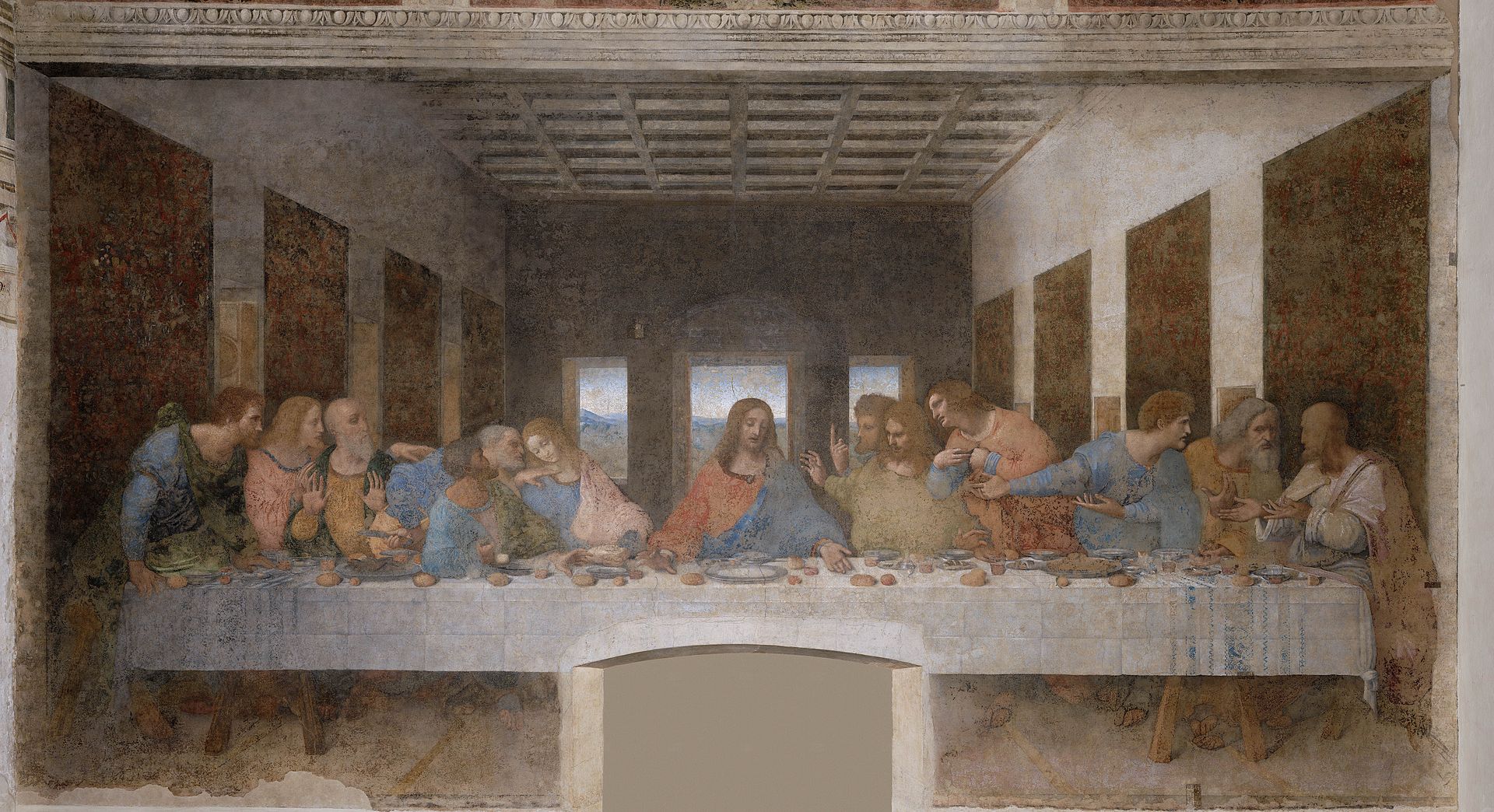
The Last Supper, Leonardo da Vinci; 1494-1499, tempera on gesso, pitch and mastic, 460 cm x 880 cm, Santa Maria delle Grazie, Milan, Italy.


The Holy Trinity – The Mystery of Three in One

017rublev troitsa

Study:  Reflect on the strongest relationships in our lives.  What qualities and characteristics are present?

Pray:  Ask the Lord for the guidance to see where we can build and renew our relationships.

Serve:  Are there people around us that we need to forgive or assist?  What steps can we take right now to start this process?

Holy Trinity Readings

Fr. Andrew’s Homily Podcast

One God…Three Persons.

That’s the Trinity, and when you get right down to it, this central mystery of the Christian faith is just that – mystery.  I have heard and used many images as illustrations to aid in understanding the Trinity:

  • Shamrock – one leaf, three petals
  • Water – one substance, three states (solid, liquid, gas)
  • Numbers – one meaning, many languages (five, cinque, etc…)

These examples (and many like them) try to get at the notion of how something can be the same and different at the same time.  How unity and diversity can be present at the same time; how the individual and the communal are manifested simultaneously.

It’s a mystery.

And at the heart of the mystery we have a communion of Persons: the Father, the Son, and the Holy Spirit – a revelation that God comes to us in communion and invites us to be communion with others.   We are not alone!  God (in communion) invites us into this communion to create communion with one another.

Where do we find communion in our lives?  Some obvious places:

  • Home & Family
  • Work
  • School
  • Neighborhood

You get the idea.  Wherever two or more are present, the opportunity for communion is possible.  The point: How strong is the communion we have have with God and one another?  How united are we in faith, hope, and love?

May we reflect on the current state of our relationships today and renew them, allowing the grace of God – Father, Son, and Holy Spirit – to bless the communion we have with those around us.

**********

Trinity, Andrei Rublev; 1411-1427 (est.), Tempera, 142 cm x 114 cm, Tretyakov Gallery, Moscow.


The Baptism of the Lord

baptism of the Lord

Study:  Recall a moment when you “died” to something sinful.  Who or what gave you strength?

Pray:  Thank the Lord for the precious gift of your life – and count your blessings!

Serve:  How can you offer some of your time or talent to help another face life and death issues?

Baptism of the Lord Readings

Fr. Andrew’s Homily

Living on the shores of Lake Superior, I am blessed with an abundance of water in my life.  Here in northern Wisconsin – with our countless clean, freshwater lakes – it is easy to take for granted this precious resource.

Yet consider these two elements of Water:

  • Life giving
  • Death dealing

Water is essential for human life.  Approximately 55-60% of our bodies are composed of water, and this crucial substance is always present wherever people are living and thriving.  What’s more, all life on our planet requires water – it simply is invaluable for existence.

Yet a surplus of water can lead to destruction.  A flood may literally wash away everything in its path with power that cannot be overcome.  Too much water and life drowns, unable to find the proper balance to survive.

This sense of life and death that we discover about water is not only true for life; it is also apparent when we discuss spiritual life.  In baptism we use water to reveal both of these aspects:

  • New life through a configuration to Jesus Christ
  • Death to sin through Christ’s death on a Cross

Through baptism, we are joined to the death and resurrection of Jesus.  Freed from sin by the Lord’s sacrifice on the Cross, we are raised up to newness of life in this world as we prepare to be united to the Lord forever in heaven.

The Baptism of the Lord by John the Baptist reminds us that our experience of God draws on our relationship with the Lord.  His life becomes our life; his death frees us from our death.  Configuring our lives to Jesus through our baptism, we not only become his disciples – we open our hearts to receive his grace.

May we call upon that grace as we face the challenges and blessings of life today.  Trusting in Christ, we engage our lives for service as we follow his example of life and death.


The Epiphany of the Lord

Brilliant Stars!

Study:  Recall a time when you experienced a moment of clarity and understanding – when it all came together.

Pray:  Ask the Lord for direction and insight regarding any particular decisions or needs.

Serve:  How can you help someone clarify their focus and gain direction?

The Epiphany of the Lord Readings

Fr. Andrew’s Homily

I was sitting in a Calculus class, and my blood was beginning to boil. For over an hour I had been trying to understand a concept without any success. The professor had patiently explained it twice (using two different examples), two friends tried (telling me how EASY it was – like that helped…), and I had read the “helpful hints” section of the textbook (which I still do not understand to this day).

I looked down on the page of equations, a seemingly meaningless series of numbers, letters, and signs, and put my head in my hands and took a deep breath. I then turned to look out the window and daydreamed for a couple of minutes. (I think the professor was just glad I was quiet…!) Then I looked back at the textbook.

It made sense.

I could not believe it. I finally understood in a span of three heartbeats what three different people had been trying to tell me for over an hour. The light bulb went on, and I said “OH!!!” just a little louder then I realized.

The professor, a gentle man with a deep faith, came over to me with a big smile. He said, “Do you get it?” When I told him how it came together he said, “Good for you, Andrew! You just had an epiphany.”

There are times in life when an event or experience comes upon us in a rush. We are caught up in the moment, held in awe by our new awareness. We discover a new insight, understanding, or perspective which shapes and changes how we see the world.

In the Scriptures today we follow the journey of the wise men, guided by a star to the baby Jesus. As the star rose they pursued its course, searching for understanding and wisdom. When they found the child their response reveals the magnitude of their convictions. They knelt in homage, giving the very best gifts they had to offer.

As we journey on in our lives God places before us opportunities and events where the Lord is especially present. In these great and precious moments our eyes are opened – if only briefly – to the grace and blessings around us. We can ask the Lord for this gift of understanding – a gift which recognizes and responds to God’s presence in our midst.


The Solemnity of Mary, the Mother of God

photo (2)

Study: Recall a time in your life when another person made a profound difference in your life.  How did they show you support?

Pray:  Ask the Lord for the wisdom and insight to be a human agent for divine love.  Pray for an open heart to be guided by Christ!

Serve:  Who in your life would benefit from your service and kindness right now?  Is it family, a friend, a co-worker, or an acquaintance?

Mary, Mother of God Readings

Fr. Andrew’s Homily

There are many ways to say, “I love you.”  Some people do it easily with words, others use gestures, physical closeness, empathy, or service.  Sometimes it happens when we respond to the unspoken questions or needs of another – anticipating the situation without even having to be asked.  Other times it is merely our presence, when we sit or walk with another beyond the necessity of words; at times like these it is simply the awareness that we are not alone that gives us strength.

Within the Holy Family we can talk about the practical ways that Mary and Joseph cared for and loved Jesus.  Providing for the Lord’s basic needs, showing affection, teaching, offering safety, and guiding with earthly wisdom are just a few of the examples that reveal how they provided a home for their son.

On this feast we can enter more fully into the gift of Mary’s life – as a mother.  The intimacy and connection between mother and child is profound.  There is a closeness – something physical, relational, and spiritual – that often uniquely touches our lives.  While it’s true that there are times when we are closer/farther from our moms, we can recognize that this bond has the power to connect with something deep within our souls.

Mary shared this connection with her Son.  Jesus, whose titles range from “Savior,” “Messiah,” “Lord of Life,” “Prince of Peace,” and “Son of God” could also claim another:

Son of Mary

The Feast of Mary, the Mother of God is a celebration where we can comprehend a bond that we share with the Lord.  Like us, he possessed this earthly connection with his mom – a connection that underscores how Christ comes to us and bridges the gap between Heaven and Earth so that we might know God.  The Lord became like us (in all things but sin) so that we could draw near to the Almighty – there is no obstacle, no boundary, no barrier that prevents us from encountering God.

Within the context of this mother/son relationship Mary had countless opportunities to say, “I love you” to her boy.  She said it with words, conveyed it with caring and comforting actions, and demonstrated it with subtle expressions of affection.  Since Jesus became like us, then he also received the blessings and joys that come from being loved in this very human, very powerful way.

As we enter into this New Year, how will we say, “I love you” to the Lord?  How will we reveal our love for Christ in the faces of our brothers and sisters?  Perhaps it’s with a word of encouragement, a random act of kindness, anticipating a need, or responding to a situation.  May we eagerly look about for ways to show our love – to the people in our lives and the Lord who put them there.


The Holy Family of Jesus, Mary, and Joseph

Holy Family - 3

Study:  Recall a time when you were particular grateful for the gift of your family.  What made the difference?

Pray:  Reflect on the needs of your family.  Thank the Lord for your blessings and offer your petitions for their needs.

Serve:  How can you help someone in your family right now?

The Feast of the Holy Family Readings

Fr. Andrew’s Homily

Big or small, far-flung or close to home…we all come from a family.  Sometimes our families are in better/worse places, depending on emotions, finances, relationships, illness, death, and a multitude of challenges and blessings that life can throw our way.

And while no family is perfect, every family provides opportunities for us to grow.  Whether it is getting along, practicing forgiveness, being patient, working together, or dealing with the idiosyncrasies that are part of every human group…there is no place like family for teaching us lessons that are part of our journey to become the best version of ourselves.

The Holy Family faced plenty of blessings and burdens.  Here are a few of the blessings:

  • Encounters with the angel Gabriel
  • Choirs of angels singing and rejoicing
  • Visits from distant Magi and nearby shepherds
  • The brilliant light of the Star as a sign from God

But, then, there are some real burdens:

  • Explaining Mary’s pregnancy (before marriage to Joseph)
  • Fleeing for their lives from King Herod’s soldiers
  • Refugees in Egypt – far from family
  • And one day…Mary will stand before the Cross of Jesus

Clearly, this family is unlike any other; yet together they faced situations that are similar to many even today.  They knew what it was like to be grateful for what they had, and they knew what it was like to face suffering and pain.

But there’s two points I want us to hold close:

  1. They did it together
  2. God was with them

What’s true for the Holy Family is true for our families!  We have opportunities to work together, cooperating and uniting to strengthen the bonds within our families – and when we face challenges we call upon the Lord to give us the grace and strength we need to put faith into family, hope into our homes, and love into our lives.

May this season give us plenty of opportunities to work together with God’s grace in our families – the place where we have been located by the Lord to practice our “homework for holiness” as we journey through this life.


The Immaculate Conception of the Blessed Virgin Mary

HarringtonWed_486

Study: When have I said “yes” to something important in my life?  What blessings came with this yes?  What challenges came as well?

Pray: Ask the Lord for the wisdom and guidance to say “yes” following the example of Mary.

Serve: How can I help support someone who is preparing to say “yes” to an important decision?  How can I help someone follow through with their choice?

Immaculate Conception of the Blessed Virgin Mary Readings

Fr. Andrew’s Homily

There are times in life when we say “yes” to important decisions.  These are moments when we formally embrace a commitment, a responsibility, and an obligation to live in a certain manner.  At times like these we define ourselves and reveal to others what we value.

Mary’s “yes” to the angel Gabriel professes an acceptance of the Lord’s call at a level of profound power.  Her words testify her openness to allow the Almighty to work through her – becoming the human agent through which the Son of God would come into our world.  The child born in Bethlehem would change human history forever.

Yet this “yes” comes with a poignant cost.  She will face hardship, violence, displacement, and the agony of watching her son suffer upon the Cross.  The cost reveals that our most important decisions are rooted in the reality that parts of life are painfully difficult – we recognize that our choices will place heavy demands upon us.

And yet, Mary’s example can inspire us to know that just as God supported her, God supports us.  Our “yes” is strengthened and sustained by the Lord’s grace.   Jesus suffered, died, and rose that we might have the consolation of his grace to help us.  Our “yes” is not made in isolation; we walk with the Lord who guides us.  May Mary’s intercession direct our words as we follow her example and say YES to her Son – the Lord Jesus Christ!


The Feast of Christ the King

Christ the King

Study: Recall a time when you recognized God as the center of your life; a time when you hung on to faith – perhaps because other things were struggling.

Pray: Call upon the Lord to rule and guide your heart.

Serve:  What is the King’s command for you today?  How is the Lord directing you to help and serve another?

The Feast of Christ the King Readings

Fr. Andrew’s Homily

The Feast of Christ the King brings the Church calendar year to a close.  Next week begins Advent, and we will start a new liturgical year with the cycle of “B” readings in the Lectionary for Mass.

Why do we end the year with the notion of Christ the King?  Why do we place this feast here?  What’s the point?

The feast has several levels of meaning.  By calling Christ our King we are making a statement that Jesus is the Lord of our lives.  It means that we place Christ first, and that we serve the Lord Jesus with the allegiance of our hearts, minds, and bodies.  We belong to Christ, who rules us.

In addition, to claim Christ as our King means that we are members of his kingdom.  Through our baptism we are called to the community of faith, the Church, and we possess an inheritance that is ultimately not of this world.  We are citizens who have a responsibility to work together – for this world and the world to come.

Furthermore, the King will come at the end of time to call His faithful people home to heaven.  We believe that the world will end on a future, unknown day (and once again, let me stress it is an UNKNOWN date…).  This feast reminds us that in the end we belong to one home or the other, one Lord or another.

Finally, to say that Christ is our King reminds us that all our power, strength, hope, and direction come from Him.  The skills and talents we possess are from the King (who made us).  The forgiveness we cherish is from the King (who died for us).  The life of the Holy Spirit which sustains us was sent by the King (who asked the Father on our behalf).

Therefore, to claim Christ as our King is to make a statement about who we are.  As followers of this King we offer our lives in service to the one who is our Lord.  We make this King our first priority in all things, and we look upon Jesus Christ as both the beginning and end of our existence.

This is a good time for us to search and prepare our hearts.  As this Church year comes to an end we begin to make ourselves ready for the Lord who comes to us, that he might find us alert and watchful for his arrival.  May we renew our allegiance to Christ our King so that he will rule us with mercy, grace, and love.


The Dedication of the Lateran Basilica

St. John Lateran exterior

Study:  Think back to churches that have real significance in your life.  What was going on at the time?

Pray:  Step into a church and take a moment to pray.  First, reflect on your blessings – thanking God.  Second – offer your petitions for special needs and concerns.  The Lord is listening.

Serve:  Do you know someone who has a hard time getting to church?  Can you help them?  Do you know someone who has been away from the Church…can you help them?

The Dedication of the Lateran Basilica Readings

Fr. Andrew’s Homily

This weekend we celebrate a feast in the Church that is a little out of the ordinary.  Throughout the year we honor saints, angels, events in the history of salvation, and seasons in the liturgical calendar.

But buildings?

Yep.  The readings this weekend are for the anniversary of a dedication of a building – a church.  Now this is not just any building; the Lateran basilica has an important place in the history and significance of our faith:

  • Pope Sylvester I dedicated it on Nov. 9, 324
  • The land was owned by the Laterani family
  • Called the “mother and head of all churches”
  • Episcopal seat of the Pope as Bishop of Rome
  • Papal residence from the 4th century to 1309
  • Site of 5 Ecumenical councils

Now why would we do this?  Why take a day out of the calendar to honor a building?  Here are few reasons:

  1. Buildings are a part of life
    – living, working, learning, praying!
  2. This church is loaded with history
    – many great events happened here
  3. Buildings can inspire and shape our faith
    – form a community for prayer/service
  4. Our faith uses buildings as an example
    – temple, dwelling, refuge, house, etc.

The readings today use the idea of a building to help reveal God’s presence among us.  The image of a building (especially a Temple) develops several themes:

  • From the Temple of God comes life
  • All dwellings (temples belong to the Lord
  • Each one of us is a Temple of God
  • Jesus described his own body as a temple

Church buildings not only serve to gather us for prayer, but they shape the very way we pray.  They are places where we recognize the Lord’s presence in a powerful way.  By honoring a particular church this weekend, we pause to remember the role that buildings (especially churches) play in our faith.

A building by itself is nothing.  A building filled with people alive for Christ is awesome.  May this feast remind us that all our buildings and bodies are simply places – created by God in order to dwell among us.

St. John Lateran interior