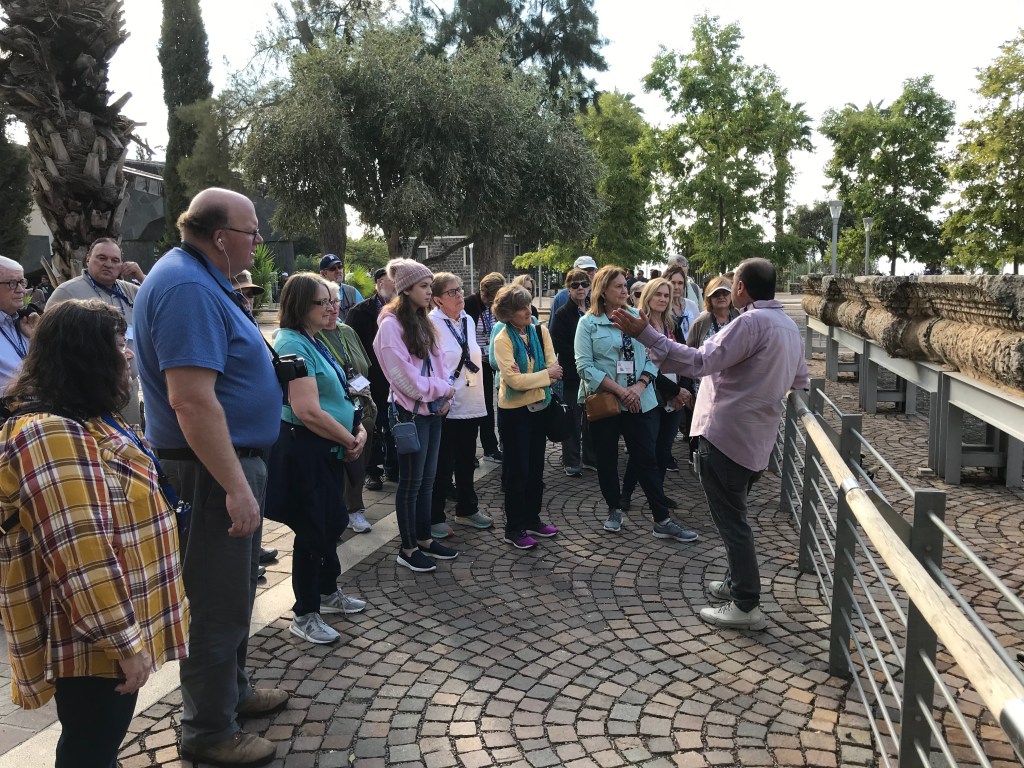
Our pilgrimage group in Capernaum, listening to our guide, Johnny.
The healing of the paralytic in Capernaum reveals the connections between faith, forgiveness and healing. May our faith grow each day as we draw closer to the Lord and one another.
John the Baptist comes on the scene blazing like a torch as he exhorts the people to repent of their sins. He minces no words with the Pharisees and Sadduccees; rather, he makes it clear that the path to God leads through the good fruit of our actions.
John is blunt and direct. There is no spin in his message, no soft touch. He comes to us as a verbal bulldozer, seeking to carve out a direct route that leads to the Lord. I can only imagine what it was like to be in his presence, eager to hear his words yet feeling the sting of his speech. After all, repentance is a great thing to talk about…but often painful to put into practice.
And yet nothing brings about healing faster than forgiveness. When relationships are wounded and we find ourselves in a broken and fragile place, repentance clears the ground and allows us to rebuild our lives in an honest and direct fashion.
Repentance has some key components:
Knowing good from bad
Taking ownership for when our actions have been bad
Seeking to turn away from the bad and strive to embrace the good
Claiming the mercy and grace of God to renew our lives
Asking for forgiveness and putting it into practice
As we prepare in this Advent season for the birth of the Messiah, we have the opportunity to examine our hearts and consider what is not worthy of the Lord. Using a good examination of conscience or just the common sense in our souls we have the chance today to repent of our sins, seek forgiveness from God and one another, and live each day in the light and power of Christ.
John tells us that while he baptizes for repentance, the Lord will baptize us in Spirit and fire – allowing us to draw into the very heart of God’s love. Only through repentance will we be able to encounter the burning intensity of divine charity; for when we stand before the Lord whatever is not fitting will burn away. May we cast out whatever is not worthy, and prepare to welcome His holy fire with open hearts.
The interaction between Jesus and the woman in the Gospel of Luke reveals the healing power of God’s love when we receive the Lord’s forgiveness for our sins.
Study: Recall a time when you experienced a moment of profound forgiveness. How did it change you?
Pray: Are you holding on to anger and resentment? Pray for God’s mercy to soften your heart.
Serve: Is there someone you know in need of mercy? Is there some way you can help others, especially when they are caught up in shame, embarrassment, or the awkwardness of their weaknesses and sins?
We hear in the Gospel of Luke the familiar parable of the The Prodigal Son. It’s worth a moment to touch on a few key points from this passage:
The younger son asks for his inheritance before his time (what kind of person does this?)
The younger son completely wastes the entire inheritance; he has no excuse
The younger son hits “rock bottom” and figures it’s better to be a servant with his dad than starving with the pigs
The Father’s mercy is overwhelming: ring, robe, sandals, fatted calf, and a party
The older son is furious – this is not justice!
The Father is also merciful to his older son as he teaches him about mercy
What a powerful parable! In our daily lives the need for forgiveness is so compelling that it is vital to dwell on the divine mercy of God and recall our need to return to the Lord in our moments of weakness and sin.
Like both brothers in the parable, we all sin and fall short of God’s grace; yet like the brothers, we also have a Father who loves and welcomes us whenever we seek to turn back. Both brothers could speak to their Father – in either humility or anger – and the Father responds to both with tenderness.
Today I would like to suggest two key points for our reflection in the light of this passage:
How are my sins keeping me from God and others in my life?
What steps do I need to take to return to the Lord and receive his grace?
God longs to welcome us back, and when we can humbly embrace our mistakes and sins we discover a grace beyond anything imaginable. May we have the courage to examine our hearts and return to the Lord – the source of all mercy.
Note: This post was first published on September 5, 2016.
If you find these posts helpful for your spiritual life:
Please follow my blog (top right corner of the screen) and you will receive an email every time I post.
Please share my posts on your Facebook page – “word of mouth” is still the best promotion!
If you use iTunes, Spotify, iHeart Radio or Radio.com (mobile app), you can subscribe to my podcasts at “Catholic Inspiration” and each new message will be delivered right to you.
Jesus Christ knows our hearts – the good, the bad and the ugly – and he offers mercy through his sacrifice on the Cross that we might have life. Take his hand!
The story of Joseph in the Book of Genesis recounts the power of reconciliation within a family. Joseph chooses the higher path and overcomes hatred and discord as he returns compassion toward his brothers. His example inspires us to examine our own families and actively seek opportunities to foster peace.
The man brought to Jesus was healed of his affliction and forgiven of his sins. God longs to heal and restore our lives, and even when we are unable to initiate the process the Lord brings people around us to make his grace possible.
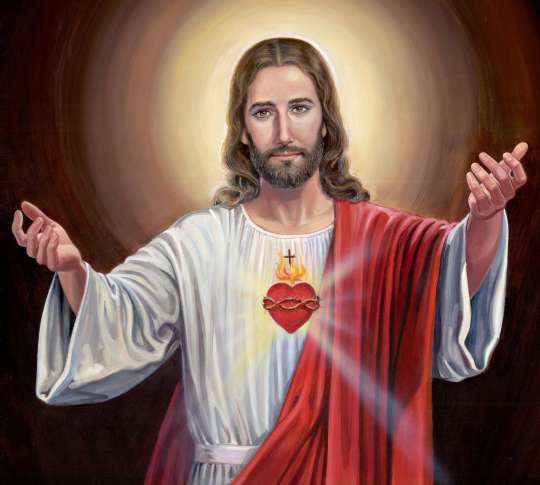
All of the readings today reveal the compassion of God that flows from the sacred heart of Christ. God’s mercy reaches out to us, invites us to reconcile, and urges us to turn away from our sins and toward the Lord. May we accept this amazing grace!
Jesus makes it clear in today’s Gospel reading (part of the Sermon on the Mount) that reconciliation is a non-negotiable aspect of Christian Life. Who do we need to reconcile with today? How can we take the first step in putting the Lord’s command into practice?













 Three Great Things