Tag Archives: Love

The Solemnity of Mary, the Mother of God

photo (2)

Study: Recall a time in your life when another person made a profound difference in your life.  How did they show you support?

Pray:  Ask the Lord for the wisdom and insight to be a human agent for divine love.  Pray for an open heart to be guided by Christ!

Serve:  Who in your life would benefit from your service and kindness right now?  Is it family, a friend, a co-worker, or an acquaintance?

Mary, Mother of God Readings

Fr. Andrew’s Homily

There are many ways to say, “I love you.”  Some people do it easily with words, others use gestures, physical closeness, empathy, or service.  Sometimes it happens when we respond to the unspoken questions or needs of another – anticipating the situation without even having to be asked.  Other times it is merely our presence, when we sit or walk with another beyond the necessity of words; at times like these it is simply the awareness that we are not alone that gives us strength.

Within the Holy Family we can talk about the practical ways that Mary and Joseph cared for and loved Jesus.  Providing for the Lord’s basic needs, showing affection, teaching, offering safety, and guiding with earthly wisdom are just a few of the examples that reveal how they provided a home for their son.

On this feast we can enter more fully into the gift of Mary’s life – as a mother.  The intimacy and connection between mother and child is profound.  There is a closeness – something physical, relational, and spiritual – that often uniquely touches our lives.  While it’s true that there are times when we are closer/farther from our moms, we can recognize that this bond has the power to connect with something deep within our souls.

Mary shared this connection with her Son.  Jesus, whose titles range from “Savior,” “Messiah,” “Lord of Life,” “Prince of Peace,” and “Son of God” could also claim another:

Son of Mary

The Feast of Mary, the Mother of God is a celebration where we can comprehend a bond that we share with the Lord.  Like us, he possessed this earthly connection with his mom – a connection that underscores how Christ comes to us and bridges the gap between Heaven and Earth so that we might know God.  The Lord became like us (in all things but sin) so that we could draw near to the Almighty – there is no obstacle, no boundary, no barrier that prevents us from encountering God.

Within the context of this mother/son relationship Mary had countless opportunities to say, “I love you” to her boy.  She said it with words, conveyed it with caring and comforting actions, and demonstrated it with subtle expressions of affection.  Since Jesus became like us, then he also received the blessings and joys that come from being loved in this very human, very powerful way.

As we enter into this New Year, how will we say, “I love you” to the Lord?  How will we reveal our love for Christ in the faces of our brothers and sisters?  Perhaps it’s with a word of encouragement, a random act of kindness, anticipating a need, or responding to a situation.  May we eagerly look about for ways to show our love – to the people in our lives and the Lord who put them there.


4th Sunday of Advent

Scrooge Tombstone

Study:  Recall a time when you were confronted with a tough decision.  What helped you to make and carry out your choice?

Pray:  Ask the Lord for the wisdom and guidance to make daily decisions that are filled with grace.

Serve:  Is there someone in your life facing tough decisions right now?  How can you help them?

4th Sunday of Advent Readings

Fr. Andrew’s Homily

A Christmas Carol

Part IV: Scrooge’s Choice

There comes a point in A Christmas Carol where we begin to understand Ebenezer Scrooge.  We’ve seen his past, present, and future – how he’s interacted with people – and we come to crux of the matter: will he make a change?  Will he embrace the warnings and lessons of the Ghosts and chart a new course for his life?

Every person has a story.  Every person has had moments of joy and sadness, success and failure, blessing and burden.  Yet in the course of our lives we have been given the gift of choosing how we will live; the Lord offers us the freedom to accept or reject a life of love.   We, too, have been given opportunities to reflect and decide how we will live.  What do we choose?

In the Gospel today Mary greets her kinswoman Elizabeth, who also recognizes something wonderful has happened.  The baby in Elizabeth’s womb leaped from joy – a sign that God was present in a powerful way.  Elizabeth understood that God was working in Mary’s life, and she responded to this insight accordingly.

There comes a moment in our lives when we discover something new.  Perhaps we have seen a mistake in the past or regret an action that we have done; at these times we encounter a reason to hope and start over.  We have a reason to live with joy.

It is this sense of hope which can give us new life.  Emerging from doubt or despair, we rediscover that God walks with and among us – helping us in moments of sadness and leading us to peace.  Yet God requires that we actively accept this invitation.  The promise of hope needs our action, and it relies on our willingness to follow.

Scrooge provides an example for us.  With the help of the Spirits of Christmas, he saw a world filled with very different possibilities.  He discovered that he need not be unhappy; he could change his life and embrace the joys which were all around him.  His willingness to see, judge, and act become an inspiration for us – reminding us that life gives us opportunities to change our ways and follow God’s call.

As Elizabeth recognized God’s presence in Mary, we too are invited to discover the Lord in our midst.  May our eyes be open to see God among us, and may we respond with hearts that are open to the abundant love which is our inheritance.


Advent Service: Reconciliation

Three Great Things

Study:  When was the last time you went to Confession?

Pray:  Ask the Lord for the guidance and strength to make an examination of conscience

Serve: Is there anything in my life that is keeping me from genuninely helping others?

Fr. Andrew’s Homily

This homily was given at a communal penance service at the Cathedral on December 13, 2014 prior to the opportunity for individual confessions.  The theme “Taking out the Trash” was used to convey that just as we need to remove the garbage from the kitchen (before it starts to stink), we also need to look into our hearts and remove what does not belong.  The encounter with grace offers us the courage to look honestly and trust that the Lord will give us the strength we need to turn to him and experience his mercy, forgiveness, and love.


30th Sunday of the Year – Living our Faith

Love God & Others

Study:  Reflect on some people who live their faith through their loving thoughts, words, and actions.

Pray:  Is there a person or situation in your life that calls for greater charity?  Ask the Lord for the wisdom and guidance to do it.

Serve:  Is there someone in your life right now who would benefit from your time, attention, and/or effort?  How can you help?

30th Sunday of the Year Readings

Fr. Andrew’s Homily

I thought I would take this week to talk about something that arises out of the gospel message. The question comes from the insight of Jesus in today’s reading. Simply put, what is the central and most important part of being a Christian? What should be the focus around which we build our lives?

The answer is explicit: LOVE.

Jesus takes the two commands, love of God and love of neighbor and links them as the heart of the Christian message – from which the teaching of the entire Scriptures finds its soul. Love is the sign of the Church, it is the proof of faith, and it is the reality which reveals to others the depth of our commitment as disciples of Jesus Christ.

But what do these commands mean for us? After all, the question for each of us is “How does the law of Love affect me? How do these commands shape my life?”
I look at this from three different angles:

* By how I THINK.
* By how I SPEAK.
* By how I ACT.

In other words, do my thoughts, words, and actions reveal the law of love in my life? When I look at myself in each of these areas do I measure up with the commands of Jesus?

Imagine that each of these parts of life could be made into a movie. I see myself watching “The Thoughts of Fr. Andrew,” followed by “The Words of Fr. Andrew,” and then “The Actions of Fr. Andrew.” Do I like what I see on the screen?

When we come to the end of our lives, I doubt if many of us will wish we had worked more, or earned more money, or bought more things. In the end I expect most of us will wish we had spent more time loving the people in our lives – through what we thought, said, and did.

This love, which comes from God, is intended for us to share while we are here on earth. Our faith tells us that one day the Lord will call us home. On that day may we find ourselves prepared; having loved one another in this life we will then step into eternal Love in the Kingdom of Heaven.


The Triumph of the Cross

triumph of the Cross

Study:  Reflect on a moment when you encountered real suffering and loss.  Where did you find the strength to continue?

Pray:  Call upon the Lord for the guidance and wisdom to carry on, especially in the midst of difficulty.

Serve:  Perhaps you are called – like Simon of Cyrene – to carry a cross for another.  Who in your life right now could use your help?

Feast of the Triumph of the Cross Readings

How many times throughout our lives have we made the sign of the Cross?  Stop and think:  at Mass; meal prayers; morning & evening prayers; special gatherings; and moments of blessing and grace.  This simple action, which we teach to children at an early age, invokes a connection with the passion of Jesus.

We adorn our homes with the Cross.  A crucifix is a common gift to a new home; they are placed in bedrooms and common areas as a reminder that Jesus is the source of our help and strength.

We adorn ourselves with the Cross in many ways:  a crucifix on a chain; a cross in our pocket; earrings; rings; bracelets; and all the extra cards, bookmarks, figurines, and miscellaneous items that remind us that Jesus died on a Cross.

The Paschal Mystery – the death and resurrection of Christ – speaks to the heart of our  faith.  Out of love for us God sent Jesus, who gave his life on the Cross that we might have eternal life.  Through his suffering and death, we recognize that God has made a pathway possible that we might all journey through this life to the gates of Heaven.

The Cross teaches us many lessons:
* Life is difficult, and at times painful
* Weakness and sin are part of our experience
* God identifies with our pain
* God dies that we might have life

At the core of our teaching the Cross stands as the testament of God’s love for us.  On one hand the Cross is an embarrassment – after all, why would God (all powerful, all knowing, supreme) choose to be humiliated?  Does that not mean that God is weak?  Why could God not take away our sins in a way that showed majesty and splendor?

Yet on the other hand, the Cross is a statement that God meets us where we are in life.  In our weakness, in our humiliation, in our low moments of doubt and sin God comes to us.  Jesus, like us in every way but sin, understands our pain because through his Cross he shares in the suffering of the world.  He knows us, and loves us even more.

Every time we make the sign of the Cross may we recall what the Lord endured for us.  May the Cross be our strength as we trust in God’s love, and may we seek to follow that love as we journey through this life toward the world to come.


23rd Sunday of the Year – Speaking and Listening

speaking and listening

Study:  When was a time when I failed to speak up?  When was a time I failed to listen?

Pray:  Call upon the Lord for the wisdom to know when to speak and when to take heart to the words of another.

Serve:  Is there someone in my life right now that I am called to speak to?  Or listen to?

23rd Sunday of the Year Readings

Do you remember the Aesop’s fable “The Boy Who Cried Wolf” that we used to hear as children? It is a simple yet profound tale. A young boy is given the responsibility to watch over the animals in the event of an attack from the wolves. Bored of his duties he calls out “Wolf!” and laughs as the area villagers come running.

Delighted with his game the boy cries “Wolf!” a few more times, each time getting the attention of the people. Finally disgusted with his actions they no longer respond, even when a real wolf shows up and attacks the child; his failure to keep watch prevented his message from being heard.

In the first reading today Ezekiel says that being a prophet is a lot like being a watchman. The watchman was responsible for protecting the people from bandits and wild animals. The watchman was required to stay alert, remaining vigilant and ready to call out in a moment’s notice should danger arise.

If danger came, and the watchman failed to alert the people, then the watchman was at fault. But if the watchman called the alarm and no one came, then the people were at fault. Simply put, if the watchman does his duty and no one comes, then those who hear the warning and fail to respond are held accountable.

Likewise, anyone who hears a word of encouragement or guidance and fails to respond is also accountable. Ezekiel, the Psalm, and the Gospel today all point out that there are times when we must open our hearts to messages that we may not want to hear. We may be tempted to “harden our hearts.”

Let’s face it. No one wants to be told what to do. No one wants to be disciplined or chastised; we love our freedom and independence too much for that! Yet there are times when the Church is empowered to keep watch, lest members of the community drift into choices and actions which are harmful and destructive.

This is not easy! The scriptures today alert us to the fact that there are moments when we may be asked to either give or receive a hard word out of love. We might have to give it – to help another from making a mistake. We might have to receive it – and allow another to help us from falling into trouble. Keeping watch is never easy, but without the support of each other, we run the risk of a far greater harm.


The Most Holy Trinity

Holy Trinity

Study:  When in your life have you experienced love without words?  How did you know that you were loved even when nothing was said?

Pray:  Ask the Lord for guidance – who am I called to love today?  How am I called to love?

Serve:  What random act of kindness can I offer today for another?  How can I let the Love of Christ shine through my efforts?

Holy Trinity Readings

Fr. Andrew’s Homily

In my travels I have found myself on occasion in the company of people who did not speak English.  Indeed, when I would try my limited Spanish or Italian (or even my Latin!), I found that we had no common foundation upon which to communicate.  I wanted to share my thoughts, but I did not possess the medium to make it happen.

As I was explaining this frustration to one of my professors, he shared with me a common language that affects us all.  It is a language that all of us can understand even though we use different words to explain it.  The language?  Mathematics.

Imagine the number five (“5”).  Around the world the number is essentially the same, yet the word to describe it is very different:
In English:    “five”
In Italian:    “cinque”
In Greek:    “pente”

You get the idea.  The number means the same, but is spoken in a different way in each language.

Through time and space God has come to humanity in many different ways.  God has communicated to us through different instruments (Prophets, Dreams, Visions, Saints, Nature…), and God has spoken in many different languages (Jesus spoke Aramaic, the New Testament is written in Greek, St. Augustine wrote in Latin…).

Yet God uses one word again and again among us – LOVE.  Indeed, we are told that God is love (1 John 4:8).  This love is seen most clearly in the mystery of the Trinity, where God comes to us in love to teach us how to love one another.

God the Father created us in love.  God the Son redeemed us out of love by his death and resurrection.  God the Holy Spirit sustains us in our lives to put this love into practice.

Jesus speaks of the love of the Father (John 15:9), and the Lord tells the disciples that out of love he will ask the Father to send the Spirit (John 14:16).  Love is the reason God made us, God saved us, and God strengthens us today.

If love is the language God shares with us, then we are invited to speak this language in our lives. Our call as Christians is to proclaim in our words and actions the love of God – Father, Son, and Holy Spirit.  For if our love is sincere, then it will communicate in a language that breaks all boundaries.


6th Sunday of Easter – Transformed by Love

Love tasks

Study:  Recall the people in life have loved us unconditionally.  How did their love help you change and grow?

Pray:  Ask the Lord for the grace to recognize the people in our midst we are called to love.

Serve:  Love takes many forms.  What can I do today for another person out of love?

6th Sunday of Easter Readings

Fr. Andrew’s Homily Podcast

For the last few months the eyes of the world have directed to the words and actions of Pope Francis.  It has been a time of extensive media coverage on the Church and its message of hope to a new generation.

During this time many people have experienced the rich treasure of Roman Catholicism.  The history, symbolism, and global significance have helped provide a deeper understanding of the internal structure of the Church.

Many people have responded to the Pope’s teaching and example.  It is an exciting time to participate in the Church, and I personally am renewed and energized in my desire to grow in my  vocation to the priesthood – even in the midst of transition and change.

Change is a part of life.  Through our experiences and encounters we develop and discover new perspectives and resources within our lives.  Change happens when we open our hearts to those around us and put into action our new insights.

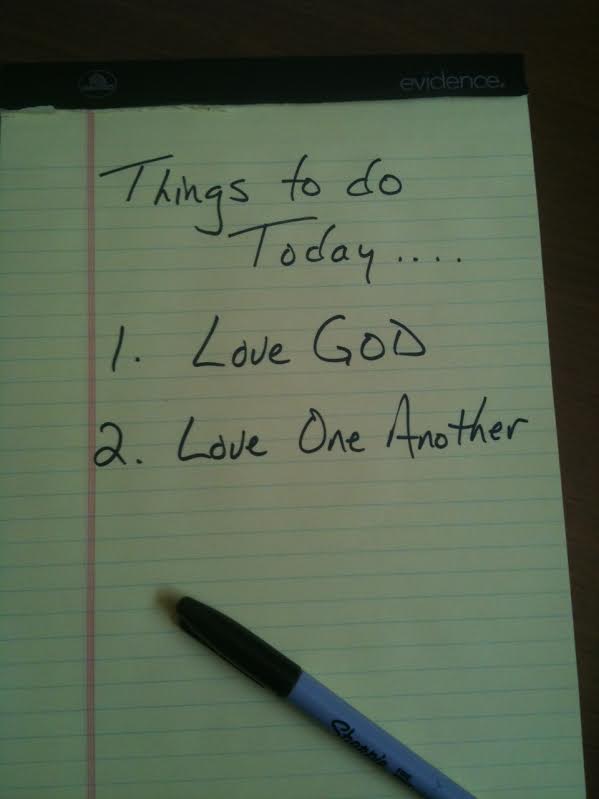
In the Gospel Jesus states that to love him means to keep his commandments.  There are two:
1.  Love God
2.  Love one another.

It is important to note that these commands are not just about being busy.  To love means to be in relationship with others; love invites us to grow in our awareness and understanding for one another.  This knowledge leads to greater respect and value for all life.

In the Gospel love is a verb.  It must be acted upon, practiced, and carried out in all parts of life.  To love means to work at a relationship – and thus be open to spend the time and effort necessary.

Yet when we open our hearts to love we are changed.  As we experience love, as we work at it, we discover that our hearts get stretched.  We become challenged to grow, to make room so that we can love more deeply, more completely.

Jesus promises that we will have help.  As we open our lives to the power of love, the Spirit will come to help us and guide us.  Transformed by love, we trust that God will continue to direct us, until the cycle of love and change brings us one day to the Kingdom of Heaven.


Easter Day

Easter Lily

Study:  When have you experienced a profound moment of change and growth?  What brought it about?

Pray:  Open your heart to Jesus Christ.  Let the joy of the resurrection transform your life.

Serve:  Claim your faith!  Let your love for the Lord direct your thoughts, words, and actions – in whatever you face today.

Easter Day Readings        Fr. Andrew’s Homily Podcast

In the early hours of that first Easter Day we celebrate an incredible hope as word spread through the city of Jerusalem – Jesus is alive.

His followers had been crushed by the agony of the Cross.  Lost – beyond all sense of pain, sorrow, and grief – from the darkness of their fear and despair they passed on the message: we have seen him, we have touched him, we have eaten with him – the Lord has been raised!

I have always been struck by the transformational effect the resurrection of Jesus had upon his disciples:

  • Fear to Faith
  • Helplessness to Hope
  • Lament to Love
  • Cowardice to Courage

The same disciples who once fled for their lives will now go out into the world to proclaim the Good News of Jesus Christ.  They will face persecution, suffering, and martyrdom in order to testify to the truth of Easter Day: the Resurrection of Christ.  What’s more, they will do this with an overwhelming sense of conviction and strength.

No one can ignore the power of this effect.  The encounter with the Risen Lord changes everything.  What is there to be afraid of?  Jesus has broken the chains of sin and death – we can face anything in this world with confidence.  Jesus has triumphed, and in the light of Easter Day we now draw on his strength to face our battles with joy.

The death of Jesus on the Cross was for our sins; the resurrection of Jesus was for our lives.  The power of Easter Day directs our attention to the sacred and precious gift of life.  Life is worth fighting for, worth dying for, and worth living for – in this world and the next.  The resurrection reveals God’s love for our lives; we are worth the sacrifice of the Cross and empowered to live with faith, hope, and love.

How will we live this great promise of faith?  How will we allow the power of Easter to transform us?  For remember: the moment we acknowledge the truth of the resurrection our lives fundamentally change.  Directed by the saving work of Christ we now engage the world on new terms: we witness through word and action the love of Jesus each and every day.  With our eyes fixed on heaven we boldly walk this earth as his disciples.  We live our lives with real truth and power.  We live our lives as God’s sons and daughters.

The authentic witness of our faith is THE WAY that people truly discover Jesus.  It was true for the disciples on that first Easter Day, and it is true for disciples today.

Perhaps today is the day that our faith takes on a deeper meaning and purpose in our lives – placing Jesus first in all that we say and do.  May this Easter Day fill our hearts with grace and power to live in the light of Christ.  May we let the Lord into our hearts and allow our lives to be transformed by his love.

Christ is alive!  Alleluia!  Alleluia!


Easter Vigil

Candlelight

Study:  How did you learn your Christian faith?  When did it become something you claimed for your own?

Pray:  This is a good time to count our blessings and draw near to the Lord in gratitude for the gift of life.

Serve:  Perhaps there is someone to whom you might want to say, “I love you.”  Perhaps this is a good time right now…

Easter Vigil Readings

This holy night finds the Church celebrating the profound mystery of Christ’s saving work.  The Easter Vigil recalls the great moments of salvation history, rejoices with those who enter into full communion with the sacramental life of the Church, and is nourished by Eucharist.  Here are the four key components:

  • The Liturgy of Light
  • The Liturgy of the Word
  • The Liturgy of Initiation
  • The Liturgy of the Eucharist

The Liturgy of Light (or Lucernarium) begins the Easter Vigil.  In the darkness the image of light is used to proclaim our hope in Christ.  Several things happen:

  • A new fire is blessed and from its flames the light of the paschal (Easter) candle is lit
  • This candle is processed into church where the faithful light their own candles from it.
  • By this sea of candlelight the great Easter proclamation of Christ our Light – the Exsultet – is offered.

The Liturgy of the Word recounts the epic story of salvation history through several Old Testament Scriptures:

  • Creation – Genesis 1:1-2.2 and Psalm 104 or 33
  • Abraham’s Sacrifice – Genesis 22:1-18 and Psalm 16
  • Passage through the Red Sea – Exodus 14: 15-15:1 and its Canticle (Exodus 15)
  • The New Jerusalem – Isaiah 54:5-14 and Psalm 30
  • Salvation Offered Freely to All – Isaiah 55:1-11 its Canticle (Isaiah 12)
  • The Fountain of Wisdom – Baruch 3:9-15 and Psalm 19
  • A New Heart and a New Spirit – Ezechiel 36:16-28 and Psalm 42-43

We then move from the Old t0 the New Testament:

  • The Gloria is sung
  • A reading from  Romans 6:3-11 – Christ, raised from the dead, dies no more!
  • The Alleluia is sung
  • The Gospel is read – Mt 28:1-10; Mk 16:1-7, Lk 24:1-12 (depending on the year)

The Liturgy of Initiation then follows where those who have been preparing to enter the Church now receive their sacraments.

  • The Litany of the Saints is sung
  • The Baptismal Font is blessed
  • The Sacrament of Baptism is celebrated
  • The Assembly renews their Baptismal Promises
  • The Sacrament of Confirmation is celebrated

Finally, the Liturgy of the Eucharist allows the entire community to draw near to the altar to receive Jesus Christ in the sacrament of his Body and Blood.  The newly baptized receive Holy Communion for the first time in the company of their fellow Catholics.  Like every Mass:

  • Bread and Wine are brought to the altar
  • The Priest prays the Eucharistic Prayer
  • The Lord’s Prayer is said, followed by the Sign of Peace
  • We receive the Lord Jesus in Holy Communion

The great promise of faith, founded upon God’s saving work through time in the history of salvation, is proclaimed on this holy night.  May Christians around the world renew their faith in Jesus Christ – sharing his love and light with one another.

Christ our Light!