Author Archives: Fr. Andrew Ricci

About Fr. Andrew Ricci

Unknown's avatar
A Catholic priest since 1997, Fr. Andrew Ricci is currently the rector of the Cathedral of Christ the King in Superior, WI. His website "Three Great Things" can be found at studyprayserve.com and his podcasts can be found under "Catholic Inspiration" in the iTunes store.

2nd Sunday of Easter – Doubting Thomas

blessings

Study:  Reflect back on a time when you experience real doubt and disbelief; was it about good or bad news?  How did you work through your doubt to grow in trust and hope?

Pray:  Take time this week to pray for faith and trust, especially about situations in your life or in the lives of others that confront doubt.

Serve:  Reach out with comfort and support to those who struggle with doubt, particularly in regards to their faith in God.  Perhaps you may be the instrument through whom the Holy Spirit will draw others nearer to Jesus Christ.

2nd Sunday of Easter Readings:

I am often fascinated by the ways that people handle good news.  In particular, I am amazed at those moments when individuals are informed or confronted by a situation that is truly delightful.

Some folks begin to stammer and stutter; others cannot speak at all.  Some giggle; others cry; and still others start to babble in sounds that have never been formulated before on this planet.

Yet while some people embrace their good news, others react differently.  These are the skeptics; they are looking for the “real side” of the story.  They do not trust the situation, but are trying to find out what is really behind all the smoke and mirrors.  They refuse to accept what they have seen.

The response is natural and often happens.  Confronted by good news, there are times when people hesitate to believe.  Experience or cynicism has left them with doubt – closing them from the possibility that fortune has blessed them.

This scenario is found in the Gospel today.  Thomas, who is not present when Jesus first appears to the disciples, scoffs at their claim that they have seen the Lord.  He makes his well known statement:

“Unless I see the mark of the nails in his hands
and put my finger into the nailmarks
and put my hand into his side, I will not believe.”

His doubt is strong:  until he SEES and TOUCHES the Lord, he will not accept the news about Jesus.  He will not believe.

Yet Jesus comes back a second time, inviting Thomas to see and touch and believe.  The Lord’s appearance moves Thomas to make his claim of faith calling Jesus both Lord and God.  While he is no longer doubtful, Jesus gently chides him that he needed sight to confirm his belief.

We journey through this life with the good news of Jesus Christ, whose resurrection gives us all the hope of eternal life.  Yet there are times when we can become like Thomas, doubting the truth of our faith and asking for signs of God’s presence.

May we see in Thomas an example of the Lord’s unrelenting love.  Just as Jesus responded to his doubt, may we come to the Lord in our weakness and seek hope and faith in our need.  May we trust that the Lord will renew us with the faith of Thomas.


Easter – Abundant Life

iPhone 034

Study:  Reflect on moments where you have experienced new life – in a relationship, in a position, in an opportunity.  Consider how your experience of new life can help you embrace the resurrection of Jesus

Pray:  Through the resurrection of Jesus Christ we have been freed from sin and death.  Take a moment in your prayer to thank God for this gift, and count your blessings.

Serve:  How might you bring the hope of new life to others?  How might your life bring life to those around you?

Easter Sunday Readings

All around us, we see signs of change as we enter the season of Spring.  The weather is (slowly) getting warmer, the snow is beginning to melt, and we await the rain to soften the earth and add much needed moisture to the ground.

These signs point to the simple fact that once again new life is bursting forth upon the land.  Spots of green start to appear on the countryside.  Flowers and plants begin to grow.  What was once dead has now been renewed.

The change of seasons shows us in a simple yet powerful way a fundamental truth in our world: out of death comes new life.  Around us we discover that from the cold and barren Winter, the earth is renewed through the annual cycle of life.  Death cannot last forever; it is shattered by the force and power of life – healing, restoring, and making all things new.

With this season of life comes new hope.  We see the changes in nature and respond with new vitality.  We want to get outside, enjoy the fresh air, maybe start a few projects (I said maybe…!), and live with a renewed sense of energy.  As we experience the signs of abundant life revealed in nature, we desire to take hold of our own lives – that we might live with a passion and intensity worthy of this wonderful gift.

Every year the Church celebrates the central mystery of our faith during this season of life.  Beyond his suffering and death on the Cross we celebrate the victory of the resurrection of Jesus Christ.  Through this redemption, we have been freed from two of our greatest fears, sin and death, and given the gift of abundant life.

As Christ rose from the dead, not even the grave could contain him, and his triumphant resurrection anchors our hope in eternal life.  We rejoice that through this mystery we now have a path to follow.  We know that death is not the final answer, we know that beyond the suffering and struggle of this life lies our hope in the abundant life of heaven.

Strengthened by our hope in Christ, we are invited to live this moment with our whole hearts.  Having received the gift of life, we are called to share that gift with love and joy, so that the abundant life of the resurrection may pour into this world as well.


Palm Sunday – The Cross of Christ

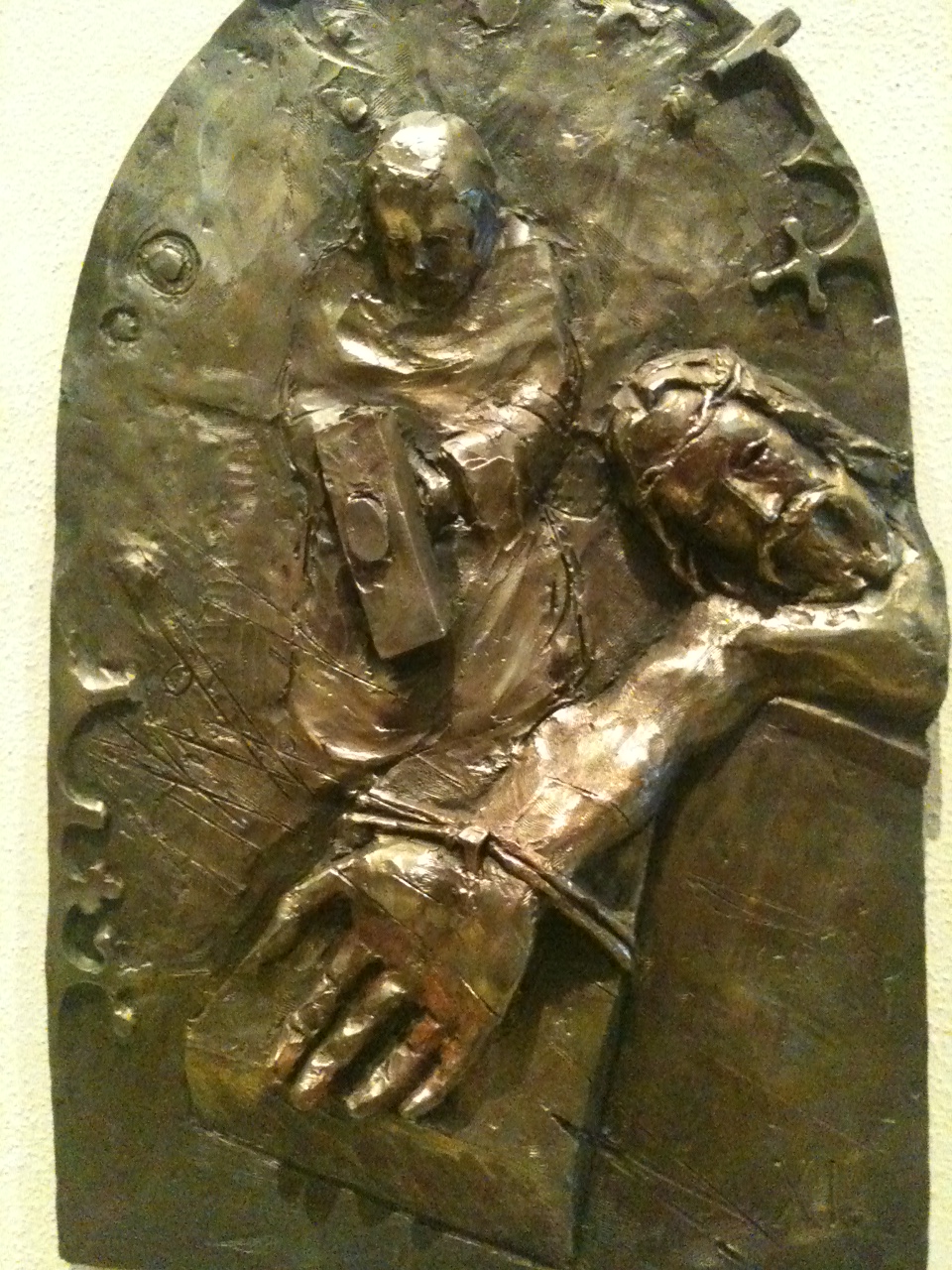
Station - Jesus in Crucified

Study: Read the Passion narrative again; put yourself in the drama of the Lord’s death. Stand with Mary at the foot of his cross.

Pray: Take time to gaze at the cross. Look beyond the art to the reality of the Lord’s passion. Dwell upon his wounds and thank him for his sacrifice.

Serve: Consider who is in need of healing in your life. Are there people who are carrying a heavy cross? Might you be like Simon of Cyrene – perhaps able to help them with a part of the load?

Palm Sunday Readings

How many times throughout our lives have we made the sign of the Cross? Stop and think: at Mass; meal prayers; morning & evening prayers; special gatherings; and moments of blessing and grace. This simple action, which we teach to children at an early age, invokes a connection with the passion of Jesus.

We adorn our homes with the Cross. A crucifix is a common gift to a new home; they are placed in bedrooms and common areas as a reminder that Jesus is the source of our help and strength.

We adorn ourselves with the Cross in many ways: a crucifix on a chain; a cross in our pocket; earrings; rings; bracelets; and all the extra cards, bookmarks, figurines, and miscellaneous items that remind us that Jesus died on a Cross.

The passion we read every year on this day focuses our attention on the central mystery of our faith. Out of love for us God sent Jesus, who gave his life on the Cross that we might have eternal life. Through his suffering and death, we recognize that God has made a pathway possible that we might all journey through this life to the gates of Heaven.

The Cross teaches us many lessons:
* Life is difficult, and at times painful
* Weakness and sin are part of our experience
* God identifies with our pain
* God dies that we might have life

At the core of our teaching the Cross stands as the testament of God’s love for us. On one hand the Cross is an embarrassment – after all, why would God (all powerful, all knowing, supreme) choose to be humiliated? Does that not mean that God is weak? Why could God not take away our sins in a way that showed majesty and splendor?

Yet on the other hand, the Cross is a statement that God meets us where we are in life. In our weakness, in our humiliation, in our low moments of doubt and sin God comes to us. Jesus, like us in every way but sin, understands our pain because through his Cross he shares in the suffering of the world. He knows us, and loves us even more.

Every time we make the sign of the Cross may we recall what the Lord endured for us. May the Cross be our strength as we trust in God’s love, and may we seek to follow that love as we journey through this life toward the world to come.


5th Sunday of Lent – Justice & Mercy

Flower

Study:  When have I truly experienced mercy from another person?  When have I been clearly in the wrong yet encountered understanding and compassion?

Pray:  Is there something in my life that needs God’s mercy?  Is there something or someone that I need God’s help to face?

Serve:  How can I practice mercy right now with someone in my life?

5th Sunday of Lent Readings

Teaching in the temple area, Jesus is confronted by the scribes and Pharisees with a woman (where is the man?) caught in adultery.  We are told that their intention is not justice, but to trap Jesus – so he can be arrested and silenced.

Here is the overview of John 8:1-11.
1           Jesus at the Mount of Olives
2          Jesus teaching in the temple area
3-6      Woman is brought to Jesus; Law is stated
7          Jesus writing on the ground
8          “Let the one without sin cast the first stone”
9          Everyone leaves; Jesus & the Woman alone
10        “Has no one condemned you?”
11        “No one, sir.”
“Neither do I…Go, and sin no more.”

Note that in this passage the Lord addresses two different groups.  The first group is composed of sinners.  His words to the scribes and Pharisees are profound:  “Let the one among you who is without sin be the first to throw a stone at her.”  Obviously, they must drop their stones; reflection and experience bring back numerous reminders of their sins.

Yet there is someone present who is without sin – JESUS!  His words to the crowd are about himself; he has the right and the authority to judge.

When the crowd finally disperses, he has the opportunity to speak to the woman.  “Neither do I condemn you.  Go, and from now on do not sin any more.”  Two crucial points surface from these words.

First, Jesus tells the truth; the behavior in question is a sin.  He does not ignore the fact, nor does he try to defend or explain it away.  He says it simply and directly.  His word is justice.

Second, the compassion of Jesus is evident in his gentle forgiveness.  He has the right to judge her, and he chooses mercy.

With the scribes and Pharisees Jesus reminds us “Do not judge, and you will not be judged.” (Matthew 7:1).  With the woman Jesus reminds us that in our sin and weakness we come to the Lord who longs to heal and restore us.

Which response speaks to us today?  We know that sin is real.  We know that all of us have failed and fallen through temptation and evil.  Do we need to ask forgiveness – for ourselves, or for presuming to judge others?  The Lord waits for us!


4th Sunday of Lent – The Prodigal Son

A man & two sons

Study:  Which one am I in the parable – the son in need of forgiveness or the son who needs to forgive?

Pray:  How does God’s forgiveness touch my heart – at Mass, Confession, or private devotion?

Serve: How can I be like the father in the parable, reaching out to those in need of the grace of repentance and forgiveness?

4th Sunday of Lent Readings

This Gospel reading is very familiar.  Let’s take a moment to break it down into its basic parts:

The Younger Son – selfish & foolish
The Older Son – hardworking & unforgiving
The Father – eager to reach out to both sons

In our reading today, we discover both the context and reason for Jesus offering this parable, as well as the central points within it.  These verses are part of Luke – chapter 15.

1-3          Jesus with sinners, the Pharisees complain
4-7         Parable of the Lost Sheep (not heard today)
8-10       Parable of the Lost Drachma (not heard today)
11-32     Prodigal Son
11-12     Younger son wants his share
13           Younger son leaves father, squanders money
14-16    Younger son penniless, works as a slave
17-19    Younger son “comes to his senses”
20a        Younger son returns to his father
20b        The father sees the son, runs to meet him
21           The younger son repents to his father
22-24    The father celebrates – his son is back to life
25-27    The older son hears about his brother
28-30    The older son is angry – speaks to his father
31-32     The father’s response to the older son

What are some of the lessons of this parable?

1.  God comes to us.
2.  God longs for our life and health.
3.  God does not force us to repent.
4.  We must “come to our senses” first.
5.  Repentance & forgiveness challenge us.

Remember, Jesus was with “sinners” at the beginning of this reading.  He was reaching out to people who had made choices in the past that had led them away from God and other people.  The parable is a way to show that God is constantly inviting us back to a relationship.

The same is true for us.  Whether we stand in need of forgiveness, or need to let go of our bitterness and anger – the Lord searches for us and invites us to celebrate whenever repentance is present and life & hope are restored.


3rd Sunday of Lent – Repentance

Lonely tree

Study: Who do I need to forgive in my life?  Who do I need to ask for forgiveness?

Pray:  How can my prayer help me repent and seek forgiveness in my life?  Is there something special I need to bring to the Lord?

Serve: How can I be an agent for healing and reconciliation in the lives of those around me?

3rd Sunday of Lent Readings

The readings in this 3rd Week of Lent are pointed in their meaning:

1.  God comes into our world (1st & Psalm)
2.  Repent!  (2nd & Gospel)

It really is simple.  God enters into our world, revealing his love and compassion.  In our response to the Lord we are called to recognize our sins and turn away from them to a new way of life.

What does this mean for us?  How do we apply these Scriptures to our lives today?  Here are a few thoughts:

1.  Take time to examine our lives.
* What is the content of my speech?
* What is the pattern of my behavior?
* What is my attitude?
* How do I treat other people?

2.  What needs to change?
* What in my life is not Christ like?
* What in my life is destructive?
* What in my life is not healthy?

3.  Make a break and start a new way!
* Take the courage to act!
* See a new way to live…and do it!

4.  Reminders…
* We do not do this alone – lean on others.
* We do not do this alone – lean on God!
* When we make mistakes, return to God!
(this is called Confession!)

We examine our lives, judge what is not of Christ, and actively change our ways.  Simple?  Yes.  Easy?  NO!!!

Repentance takes honesty, hard work, and a commitment to grow closer to the Lord.  When we repent we make the claim that there are parts of our life that are not right – something needs to change.

As we continue on our Lenten journey, we explore and renew our relationship with the Lord.  We can see if our lives are in harmony with the faith we profess.  If there is something that has to change, we trust in the Lord for the courage to repent.


2nd Sunday of Lent – A Ray of Light

Image

Study:  What sources of faith bring light to your life in wisdom and knowledge – Scripture, Catechism, Sacraments?

Pray: How does prayer strengthen you?  Is it in silence, with music, in faith sharing, or at Mass?

Service: How do you bring light to the lives of others?  What acts of kindness & charity help others, especially in their struggles and challenges?

2nd Sunday of Lent Readings

Have you ever been outside on an overcast day?  On cloudy days I find myself longing for the sun.  Everything looks drab and gray, and the world appears lifeless and cold.

On occasion there will be a break in the clouds, and sunlight will flood the landscape.  In a moment everything changes.  Colors appear, water sparkles, and the brightness makes your eyes squint.

It’s not that the landscape changed.  Everything is the same as before.  What is different is the light which gives our eyes a new perspective.  The light brings out the glory and beauty which we could not notice earlier.

In the Gospel today Jesus leads Peter, James and John up a mountain to pray.  The Lord, whom they had known now for some time, suddenly changes before them.  The man they knew now is revealed as a mighty and powerful person, surrounded by great figures from the past and authorized by the Father’s voice.

The disciples don’t know what to do or say.  Overcome by the glory of Jesus, Peter starts talking without even knowing his own words.  The Lord’s transfiguration changes what they know about Jesus; he is no longer just the teacher – he has been revealed in a profound way as God’s son.

He is still the same man they knew:  the teacher, the healer, the kind and gentle friend.  Yet suddenly they discover that he is much, much more.  His power and authority are revealed, even if for just a moment.  A ray of light has shown the disciples that they are in the savior’s midst.

As the Lord approaches his suffering and death in Jerusalem, his transfiguration reveals that the Cross will not be the end of the story.  His glory and might will transcend his earthly pain, for as the disciples have seen on the mountain, Jesus is the Lord of all creation.

Sometimes we, too, need a ray of light in our lives.  Caught in darkness or doubt, we can become gloomy, despondent, sarcastic, or fearful.  It is at these moments that we call to God for the sight which will help us see the hope and peace within life.

The transfiguration does not take away pain; it shows that God is greater than the suffering and struggle of life.  May we look to the Lord’s example to find the ray of light we need in our dark moments.


1st Sunday of Lent: In the Desert of Fear

Desert

Study: How did Christ face his fears?  How can we face our own?

Pray: Ask God for the help to face our fears and offer thanks for moments of grace.

Serve: Many face fears each day through temptation; how can we help them overcome their obstacles?

1st Sunday of Lent Readings

My experience and imagination tell me that the desert is a dry and barren place, absent of the typical signs of life.  Compared to the vegetation and animal life many of us know, the desert can seem to be a place where there is nothing at all.

This sense of “nothing” can be very profound.  The bleakness of the desert can lead to a sense of quiet.  Without the distraction and abundance of other living things, a person can often contemplate on problems and concerns, doubts and fears that lie within the heart.

Jesus was led to the desert.  After his baptism the Spirit directed him to a place of barren solitude where he would be tempted.  Alone and without the basic conforts of life, the Lord confronted the issues that would surface throughout his ministry.

In the three temptations, the Devil uses fear to keep Jesus from his mission.  The first temptation, turning stones to bread, forces Jesus to face the fear of bodily harm.  Knowing he is God, Jesus could have allowed himself to never physically suffer.  Yet the Lord says that there is more than just the body.

The second temptation, bowing to the Devil to receive the kingdoms of the earth, shows Jesus the fear of being powerless.  The miracles he will later perform testify to his power and might.  Jesus, however, places his hope in God alone.

The third temptation, falling from the Temple, addresses the fear of death.  The devil tempts Jesus to take the easy way, avoiding the pain that his suffering on the Cross will cause.  Yet the Lord again responds with confidence – for God is not to be tested to “prove” his power.

These three temptations are a foreshadowing of what will come.  Through his death on the Cross the Lord will encounter all of these fears.  His body beaten and tortured, alone and abandoned, left to die as a criminal – the Lord will endure these fears in the saving act that sets us free.  The temptations Jesus rejected in the desert he confronts in life, but he faces them in spite of the fear they cause.

The Lords temptation in the desert becomes an opportunity for us to examine our hearts.  There are times when God leads us to a barren place, where we are isolated and free of the distractions of life.  At these moments we may face our fears, seeing clearly those issues which keep us from living our lives as the Lord intended.